
5 Specifications That Actually Matter When Buying Winter Insulation Curtains in Sydney
Walk into any Sydney curtain showroom in June and you will hear a dozen terms used almost interchangeably — blockout, thermal, energy-saving, insulated, premium quality, heavyweight. Walk online and the situation is much the same. The labels rarely line up with each other, and rarely line up with what actually keeps warm air inside your living room when a cold southerly rolls in after dark and the temperature in the western suburbs drops into single figures.
There is a bigger point hiding underneath all of it. Most Australian homes were built for summer, not winter — single-glazed, lightly insulated, and draughty around the frames. As much as 40 per cent of a home's heating energy escapes straight back out through the windows. That is exactly the gap a properly specified curtain is meant to close, and it is why the right curtain matters in Sydney even though our winters are milder than Melbourne's.
The honest truth, after years of cutting, packing and dispatching curtains to homes from Penrith to Bondi, is that the thermal performance of a curtain depends on five measurable specifications. Not the marketing name on the product page. Not the price. Five numbers and material choices you can ask about, compare across suppliers, and verify with a free sample before you spend a dollar. This guide walks through those five specs in the order they matter for a Sydney winter, and finishes with a short checklist to put to any supplier before you place an order.
Spec 1: Blockout, Thermal or Light Filtering — Three Different Products
Blockout, thermal and light filtering are three different things, and a single curtain will not necessarily be all three at once. (If you are weighing the same choice in blinds rather than curtains, our guide to blockout versus light filtering covers that side of it.)
A blockout curtain stops 99 to 100 per cent of light. The goal is darkness — a fully drawn blockout at midday should leave the room visibly dim — achieved with a tightly woven face fabric plus a coating or backing that closes off the remaining pinholes. Importantly, a curtain can be a true blockout and still have only modest thermal performance.
A thermal or insulated curtain takes a blockout fabric and adds a dedicated thermal layer — most commonly a polyester thermal interlining sewn into the construction, or an acrylic foam backing applied to the rear of the face fabric. This is the layer that traps warm air against the glass and slows the convective heat loss that drives winter heating bills. A light-filtering curtain does neither of those jobs well; it softens incoming daylight and gives daytime privacy, but it is not a winter heat-retention product.
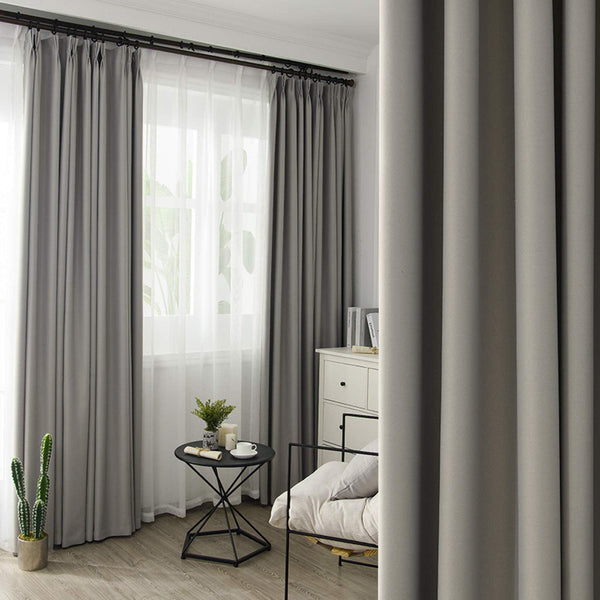
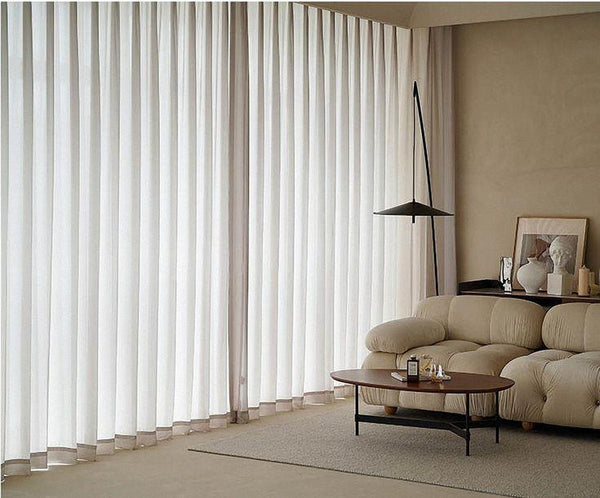
The test when shopping: ask whether the curtain has a thermal interlining or just a blockout coating. If the answer is unclear, request a sample. NSW Climate and Energy Action recommends close-fitting, lined curtains made of tightly woven material to trap air, and a sheer paired with a separate, heavier curtain gives the best year-round result. Our blockout curtains and sheer curtains ranges are designed to combine on a double track for exactly that purpose.
Spec 2: GSM — The Single Most Telling Number
If you can only get one specification out of a supplier before committing, make it GSM. Grams per square metre is the weight of one square metre of the curtain fabric, and it correlates closely with thickness, weave density and the air-trapping ability that matters in winter.
Australian curtain fabric typically sits in three bands. Light polyesters used for sheers and light filtering hover around 250 to 350 GSM. Mid-weight blockout fabrics — what most mainstream retailers sell as their entry blockout — sit around 380 to 450 GSM. Heavier thermal blockouts, the fabrics built specifically for winter performance, range from roughly 500 GSM up to 700 GSM at the premium end.
For meaningful winter insulation, look at 400 GSM as a sensible floor and 500 GSM or higher as the target. The difference is not subtle. A 500 GSM fabric is noticeably heavier in the hand, hangs in deeper natural folds, and seals more reliably against the bottom rail and the side wall by virtue of its own weight.
The trap is that many online listings advertise "premium quality" or "heavyweight blockout" without giving a number. That is not necessarily dishonest, but it does mean you cannot compare. Australian mainstream retailers vary widely in their disclosure here, and the standard varies further across imported product. If your supplier offers free samples — every reputable one does — request swatches in a comparable size and feel them against each other on a flat surface. A 280 GSM fabric and a 500 GSM fabric feel like different categories of product, and you will not need a scale to tell the difference.
Spec 3: Lining Type — Where the Real Insulation Lives
Behind the face fabric sits the layer that does most of the thermal work. Three constructions are common in the Australian market.
The cheapest blockout curtains are single-layer constructions: a face fabric with a coating applied to the back. They block light effectively and offer some thermal performance, but the coating is thin and the insulation value is modest.
The next step up is an acrylic foam backing — typically one to two millimetres of foam sprayed or rolled onto the back of the fabric. This is the construction used in much of the commercial blockout market and it offers a meaningful thermal improvement over a plain coated single layer.
The strongest performer is a polyester thermal interlining: an independent layer of insulating fibre sewn between the face fabric and the lining. It costs more, sits heavier on the rail, and gives the best winter heat retention of the three common constructions.
For most Sydney homes, a single well-specified thermal blockout layer handles a typical winter well. But Sydney is not one climate. The western suburbs around Penrith and the Hawkesbury, and the cooler ground rising toward the Blue Mountains and the Southern Highlands, get genuinely cold winter nights — and so do older, draughty homes anywhere in the metro. In those settings the configuration that performs best is a double-curtain setup: a sheer on the inner track for daytime light, a thermal-lined blockout on the outer track for evening heat retention. NSW Climate and Energy Action's guidance on draught-proofing and reducing heat loss through windows supports this layered approach as one of the more effective steps a renter or owner can take without structural work.
Spec 4: Width and Side Sealing — The Variable Most People Get Wrong
This is where many otherwise good curtain purchases quietly underperform. The physics is unintuitive: a curtain insulates not by blocking conduction through the fabric, but by interrupting the convection loop in which warm room air slides down the cold window surface and pulls more warm air behind it. To interrupt that loop you have to seal the perimeter, not just cover the glass.
The total width of the curtain pair should be roughly two to two-and-a-half times the width of the window, not one-to-one with the window. That fullness produces deep folds that close cleanly in the centre — and crucially, it produces a meaningful overlap of around five to ten centimetres where the two panels meet. A "just touching" centre seam will leak warm air all night.
The side projection matters just as much. Each panel should extend about fifteen to twenty centimetres past the window frame on each side. Without that overhang, cold air can slide around the edge of the panel and travel along the wall before mixing back into the room.
The top of the curtain is the third sealing point, and the one most often overlooked. A standard rod-mounted curtain leaves an open gap above the heading, through which warm air rises and cools against the wall — the technical fix for which is a pelmet or a ceiling-mounted track, and which deserves its own treatment in our Pelmets and Hidden Sealing Hardware article.
The pattern we see most often: customers order curtains exactly the width of the window, hang them, and conclude that their thermal curtains "don't really work". The fabric is fine. The fit is the variable.
Spec 5: Length — Ceiling Mount and Floor Pooling Beat Window-Sill Every Time

Length is the fifth specification, and it is where the biggest gains live for the smallest decision.
A curtain that finishes at the window sill — a traditional short style still sold widely — retains very little heat. The space below the sill, between the curtain hem and the floor, becomes an unsealed channel through which cooled air keeps sliding down to the floor and pulling more warm air behind it. The thermal performance is close to having no curtain at all on the lower half of the wall.
A floor-length curtain that just touches the floor performs substantially better. A floor-pooling curtain — one cut intentionally five to ten centimetres longer than the floor-to-rail height so that the hem rests on the floor in a soft pool — performs better again, because it forms a near-airtight seal at floor level.
Combine floor-pooling with a ceiling-mounted track, where the track sits up at the ceiling line rather than just above the window frame, and the curtain effectively divides the room from the window cavity along the full vertical surface. This combination — ceiling mount plus pooling, paired with the side sealing in Spec 4 — does the structural work that no fabric upgrade by itself can replicate.
For households who prefer not to install ceiling-mounted track themselves, our professional measure and fitting service covers track installation and curtain hanging across the Sydney metro and most of NSW. Customers ordering made-to-measure curtains and blinds can specify pooling at the measurement stage at no extra lead time.
A note on cordless safety: where curtains are paired with corded blinds, the ACCC's mandatory standard for corded internal window coverings applies, particularly in nurseries and any room used by young children. Cordless track systems and tie-down devices remain the safe choice in those settings.
Seven Questions to Ask Before You Order
Before you commit to any curtain — ours or anyone else's — these seven questions will tell you whether the supplier is being specific. What is the GSM of this fabric? Is the lining a single-layer blockout coating, an acrylic foam backing, or a polyester thermal interlining? What total panel width do you recommend relative to my window? Can I do a ceiling-mount track install, and do you supply ceiling brackets? Do you offer floor-pooling as a length option? Can I order a free sample to compare the GSM in my own hand? And can I combine a sheer with a thermal blockout on a double track for daytime light and evening heat retention?
Any reputable Sydney supplier should answer all seven without hedging. If they cannot, the free sample pack is the safest next step before you spend further money.
The Real Cost of Skipping the Specs
The pattern we see in retrofit customers is consistent. A household buys a 280 GSM curtain marketed as "premium blockout", hangs it at sill length on a rod above the window frame, runs an electric heater harder than they need to all winter, and replaces the whole setup two or three years later with a properly specified thermal blockout at ceiling mount with floor pooling. The replacement is what should have been bought the first time, and the intervening years of higher heating bills do not come back.
The curtain decision is genuinely a five-to-ten-year decision, and the marginal cost difference between a poorly specified blockout and a well-specified thermal setup is small compared to the cumulative heating cost difference over that window. Used well, the five specifications above make Sydney winter curtain shopping considerably less mysterious — and considerably less expensive over the life of the curtain.
GSM ranges and lining categories cited in this article are typical of the current Australian market; specific fabric specifications should be confirmed against each supplier's published technical data. NSW Climate and Energy Action, the ACCC and your installer remain the authoritative sources for energy guidance, safety standards and fitting advice respectively.