
Layered Window Treatments for Sydney Homes: How to Combine Curtains, Sheers and Blinds
Why One Layer Won't Do — The Sydney Window Problem
A single window covering is asked to do four things at once in a Sydney home: filter the harsh summer afternoon sun on a west-facing living room, hold heat in on a winter morning, give daytime privacy in a kitchen, and turn the bedroom dark enough at night for actual sleep. No single product does all four well. The roller that gives privacy is too thick to filter softly. The sheer that filters beautifully gives no privacy at night. The curtain that blacks out the bedroom is wrong on a kitchen window.
The answer in most Sydney homes built in the past three decades is layering — two or sometimes three coverings running together so that each does the part it does best. Layered window treatments are how Federation homes in Strathfield, Victorian-Edwardian terraces in Burwood, and modern apartments in Homebush, Concord and Five Dock all end up with windows that work in summer and winter, day and night.
This guide covers which coverings combine, which fight each other, what order they hang in, and where the hardware goes. CAS Blinds has been making and installing window coverings from our Homebush West factory since 2000; layered treatments are the conversations we have most often with homeowners upgrading from a single-product setup.
The Three Layers — Roles, Materials, Compatibility
A layered window treatment in a Sydney home usually involves two of three layers. Knowing what each layer is for tells you which combinations work and which don't.
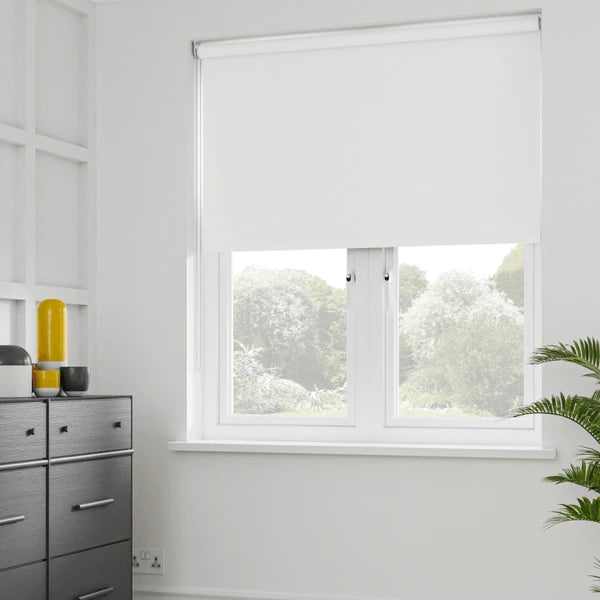
The functional layer (blinds). Blinds do the heavy lifting on light control and privacy. Roller blinds in blockout fabric give the darkness you want at night in a bedroom; in light-filtering fabric they soften daytime glare without blacking out. Vertical blinds suit very wide windows and sliding doors where rollers become impractical. Venetian blinds in timber or PVC give precise slat control. The functional layer mounts inside or just outside the recess.
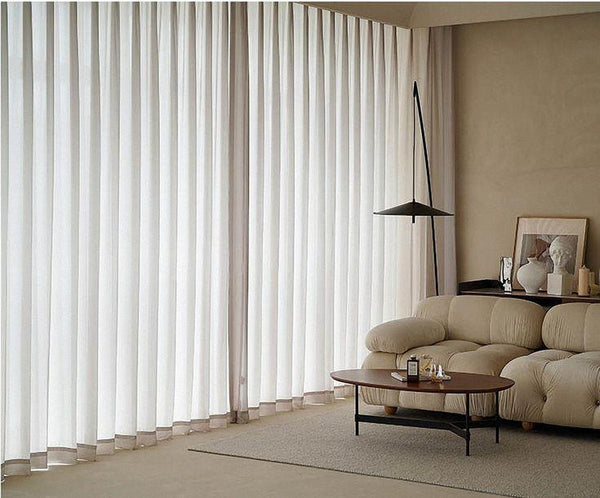
The diffusion layer (sheers). Sheers do for daytime what blinds do for night — filter direct sun into softer ambient light and provide daytime privacy without closing the room in. Linen-blend sheers are the standard; pure linen reads more natural and slightly textured, polyester-blend sheers hang flatter and clean more easily. Sheers go on a separate track in front of the blind, set out from the wall so they swing freely.
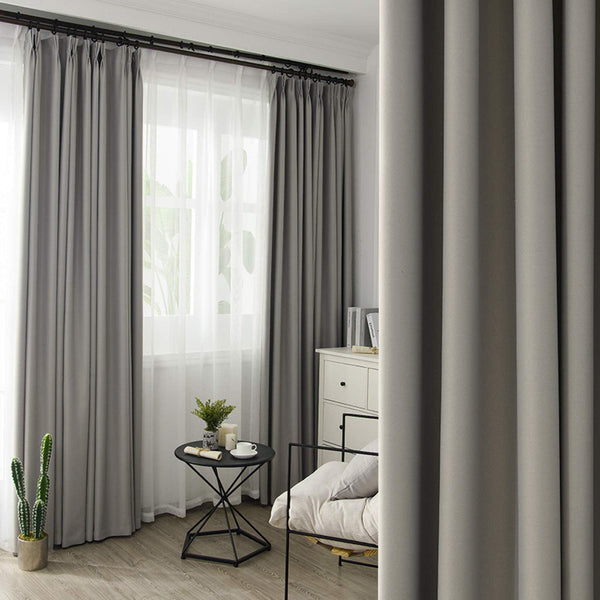
The decorative layer (curtains). Heavy curtains do three jobs: a winter thermal seal at night against a single-glazed window, full blackout when paired with a blockout liner, and a visual frame that softens the architecture. They go on the outermost track, full-length to the floor, with a fullness ratio of 2× to 2.5× the rod width to look generous rather than stretched.
Combinations that work:
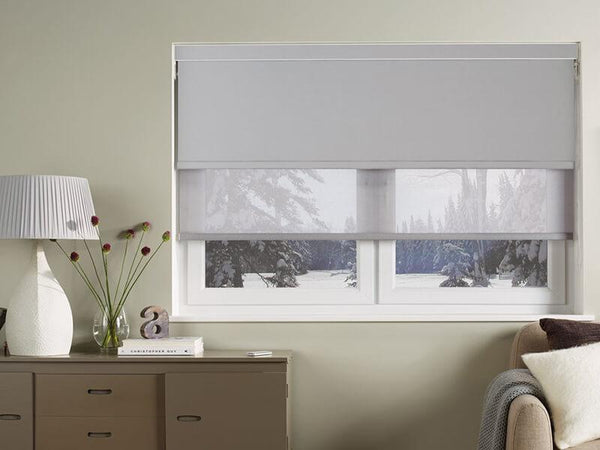
- Blockout roller blind + linen sheer curtain. The classic Sydney bedroom solution. Roller for night, sheer for day, no third layer needed.
- Light-filtering roller blind + blockout pinch-pleat curtain. Living-room friendly. Light filter for daytime, full curtain for evenings or movie nights.
- Plantation shutter + sheer curtain. Higher-end aesthetic; the shutter handles functional duty, the sheer adds softness without obscuring the shutter when open.
- Sheer curtain on its own track + blockout curtain on a second track. A curtain-only solution where the blind layer is replaced by the inner curtain. Works in heritage rooms where a rolled blind reads wrong stylistically.
Combinations that fight each other:
- Two opaque curtains layered (blockout over dim-out). The outer curtain hides the inner curtain entirely — you have paid twice for one effect.
- Vertical blinds + sheer curtains on the same track or bracket. The vertical blind's bottom chain catches the sheer's lower hem during operation. On separate tracks with 80 to 120 mm of clearance and a sheer that stops short of the floor, the combination becomes workable — see Combination 5 below.
The compatibility check is mostly mechanical: do the layers physically clear each other when they operate? Walk through bracket positions and clearances with your installer before the order is locked in.
Five Combinations for Five Common Sydney Rooms
Five layering recipes that come up repeatedly in Sydney homes.
Combination 1 — The Sydney Bedroom: Blockout Roller Blind + Sheer Curtain. Mount the blockout roller inside the window recess for the cleanest blackout perimeter; mount the sheer curtain on a separate track 8 to 10 centimetres in front, full-height to the floor. Operating order: sheer drawn during the day for soft light and privacy, roller pulled down at night for sleep. This combination works for a bedroom most of the time — including children's rooms and guest rooms.
Combination 2 — The North-Facing Living Room: Light-Filtering Roller + Blockout Pinch-Pleat Curtain. Sydney north-facing living rooms get genuinely fierce midday sun in summer. The light-filtering roller cuts the worst glare while keeping the room readable; the blockout curtain takes over after sunset for movie nights, winter thermal comfort, and full blackout when needed. The curtain runs floor-to-ceiling on a high-mounted track to add visual height. This is the single most common upgrade brief we see for Strathfield, Burwood and Five Dock living rooms.
Combination 3 — The West-Facing Bedroom in Summer: Double Roller Blind + Sheer Curtain. Where the late-afternoon sun hits a bedroom hard enough that a single blockout roller leaves the room either too dark or too hot, a double-roller bracket — light-filtering roller and blockout roller mounted together on one bracket — solves the problem cleanly. Ask about this option when booking your free in-home measure. The sheer goes in front on its own track. Three layers of light control, two operating mechanisms, one window.
Combination 4 — The Heritage Living Room: Plantation Shutter + Sheer Curtain. For a Federation or Edwardian home where rolled fabric blinds read wrong stylistically, plantation shutters mounted in the window frame solve the functional duty. A linen sheer on a separate floor-length track in front softens the shutter detail without hiding it when the shutter is open. The longest visual lifespan of any combination here.
Combination 5 — The Apartment Living-Dining Open Plan: Vertical Blind + Sheer Curtain on Separate Tracks. Wide sliding doors in modern apartments are where vertical blinds genuinely shine — they handle the width and the tilt better than roller alternatives. A sheer curtain on a separate ceiling-mounted track running the full slider width softens the verticals' hard edges. The two layers must be on independent tracks with sufficient clearance because the verticals' bottom chain will catch a low-hanging sheer; brief your installer specifically on clearance and sheer drop length.
The pattern across all five: layering responds to the room's purpose and the window's exposure, not a catalogue hierarchy.
Room-by-Room Recommendations

Bedrooms. Blockout roller plus sheer is the working default. If the room is heavily west-facing, upgrade to a double roller plus sheer. Light-filtering rollers alone leave a bedroom too bright for early-morning sleep in summer; expect to upgrade within the first season.
Living rooms. Light-filtering roller plus blockout pinch-pleat curtain handles most living-room briefs. North or west-facing living rooms with late-afternoon glare benefit from the upgrade to a double roller plus curtain.
Kitchens. Single layer is usually correct. A roller blind in light-filtering fabric, mounted inside the recess to keep the splashback clear, with no fabric over the top — curtains and cooking grease are a poor pairing. PVC venetians or aluminium shutters are the wet-area-friendly alternatives.
Bathrooms. Single layer; PVC venetians or aluminium/composite shutters are the right answer. Fabric anywhere near a shower is a maintenance problem you will lose.
Studies and home offices. Light-filtering roller is the daytime worker; if the room doubles as a guest bedroom, add a blockout liner curtain or upgrade the roller to double. Glare control on screens is the actual brief, not aesthetics.
Dining rooms. Light-filtering roller plus blockout curtain, often with a sheer between for a more formal aesthetic. Three layers works in a formal dining room because the room is rarely used in two states (full sun, full evening) and the operating sequence is occasional, not daily.
Children's rooms. Blockout roller plus sheer, with full attention to corded-window-covering safety (covered in the next section). Cordless or motorised operating mechanisms only. Tie-back hardware mounted high enough that a child cannot reach a loose cord.
Hardware, Tracks and Installation Order
Two or three separate fixings have to coexist on the same wall without interfering. Installation order is set by the site measure, not the catalogue.
Track and bracket spacing. The blind layer mounts inside or just outside the window recess. The sheer track sits 80 to 120 millimetres further out from the wall on a wall-fixed bracket; the curtain track another 30 to 50 millimetres further out from that. Total projection from the wall to the outermost curtain track is usually 200 to 250 millimetres. Walls without enough projection (recessed windows, narrow rooms) constrain what layering is achievable.
Drop and width allowances. Sheer and curtain layers extend beyond the window by 100 to 200 millimetres on each side and run from ceiling-mounted track to floor for the cleanest aesthetic. Blinds run inside the recess for the cleanest light seal. The visual gain from running curtains floor-to-ceiling rather than just to the sill is significant in rooms with normal ceiling heights.
Operating systems and child cord safety. Corded blinds and curtains in Australia are governed by the ACCC Consumer Goods (Corded Internal Window Coverings) Safety Standard 2022, enforced under the Competition and Consumer Act 2010. The operative rule: any loose or looped cord must not form a loop 220 millimetres or longer at or below 1,600 millimetres above floor level. In practice, loose cords must be secured with cleats or tension devices fixed to the wall or window frame above 1,600 mm, or replaced entirely with cordless or motorised operation. One or two children die each year in Australian homes from non-compliant corded window coverings; ACCC enforcement carries civil penalties for both suppliers and installers. Motorised systems on roller blinds remove the cord risk entirely.
Free measure and quote. Layered treatments are where the paper plan most often differs from what works at site. A free in-home measure across the Sydney metropolitan area resolves bracket-spacing, wall-projection limits, and hardware-clearance issues before the order is placed.
FAQ — Layered Window Treatments
Can I use the same fixings for the blind and the curtain?
Generally no. Blinds need to mount close to the glass for the cleanest light seal; curtains need to project enough that they do not catch on the blind when drawn. They want separate brackets and a small horizontal gap between them.
Are sheer curtains warm enough for a Sydney bedroom in winter?
Sheers alone are not a thermal layer. They diffuse light. The thermal job in a bedroom is done by the blockout roller pulled down at night, or by a heavy lined curtain layered behind. If your room is genuinely cold in winter, the curtain layer matters more than the sheer.
Will my landlord install layered window treatments in a rental?
Some will, particularly for longer leases. The conversation usually involves a written request, a quote, and an agreement about what stays at end-of-lease. Many tenants instead use removable tension-rod sheers behind existing blinds as a renter-friendly partial upgrade.
Are the cord-safety requirements for children's rooms a rule or a recommendation?
A rule. The ACCC Consumer Goods (Corded Internal Window Coverings) Safety Standard 2022 is mandatory under Australian Consumer Law, with civil penalties for non-compliant supply and installation. Cordless operation, breakaway connections, or motorised systems are the compliant paths; loose cords with no anchorage are not compliant.
Can I DIY a layered window treatment install?
Single layers in standard windows are within reach for a confident DIYer. Layered systems with three brackets per window, child-safe operating mechanisms, and clearance management between layers are usually beyond typical DIY work.
Do plantation shutters need a layer in front?
No, but a sheer curtain in front softens the look and is a common premium combination in heritage homes. The shutter on its own is functionally complete; the sheer is purely aesthetic.
Building the Right Layered Solution for Your Sydney Home
A single window covering forces a compromise. Layered treatments give each layer one job to do well. Most Sydney homes benefit from a two-layer setup in their main rooms — blockout roller plus sheer, or light-filtering roller plus blockout curtain — with single-layer solutions in wet areas. Three layers belong in formal rooms and difficult exposures.
CAS Blinds has been making and installing window coverings out of our 38 Richmond Road factory in Homebush West since 2000. We do roller blinds, vertical blinds, venetian blinds, sheer curtains, double curtains, ready-made curtains, awnings and plantation shutters across both DIY ready-made and custom-fit programmes. Factory-direct, family-run, with free in-home measure and quote across the Sydney metropolitan area — including Strathfield, Burwood, Concord, Five Dock, Homebush, Ashfield and Croydon.
Walk through more layered ideas in our existing guides on pairing blinds and curtains and choosing the right blinds for your home, or book your free measure and quote directly.