
Roman Blinds: A Buyer's Guide for Sydney Homes
Roman blinds sit somewhere between a blind and a curtain. They cover the window neatly like a blind, but they're made of soft fabric that folds into layered pleats when you raise them, which makes a room feel warmer and more finished. They're a popular choice for bedrooms and living rooms, but they aren't right for every window.
This guide explains how Roman blinds work, where they suit best, how they compare with roller blinds and curtains, and what to check before you measure and order.
What is a Roman blind?
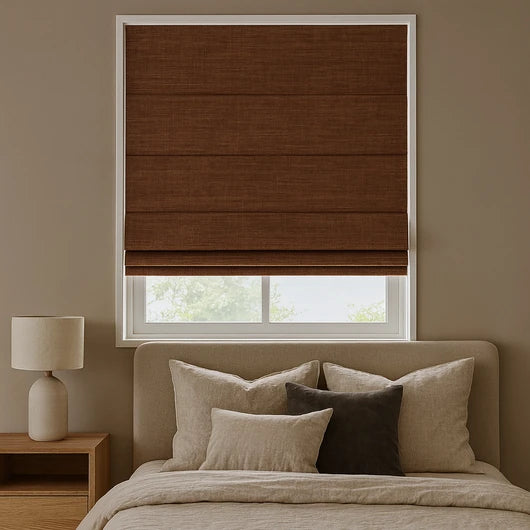
A Roman blind is a flat panel of fabric with horizontal pockets or folds sewn across the back. When you raise it, the fabric gathers into neat, overlapping pleats at the top of the window. When it's down, it lies flat and covers the glass completely.
Because the fabric folds rather than rolls, a Roman blind looks closer to a curtain than to a roller blind. It is a good way to bring texture and softness into a room without the width of a full set of curtains.
Roman blinds vs roller blinds vs curtains
| Roman blinds | Roller blinds | Curtains | |
|---|---|---|---|
| Look | Soft, tailored pleats | Clean and minimal | Soft and full, floor-length options |
| When raised | Fabric stacks at the top of the window | Rolls up compactly into a slim roll | Draws to the sides of the window |
| Space needed | Height above the window for the stack | Very little | Wall space beside the window |
| Best for | Bedrooms, living rooms, standard windows | Almost any room, wet areas with the right fabric | Large windows and sliding doors |
If you want the softness of fabric but the windows sit close to the ceiling or the wall beside them is limited, a Roman blind is often the best compromise. If you want the most compact option, see our roller blinds; for very wide openings, curtains are usually easier.
Where Roman blinds work best
- Bedrooms. With a blockout fabric, a Roman blind gives privacy and darkness with a softer look than a roller blind.
- Living and dining rooms. Fabric pleats add texture and help a room feel finished, especially with neutral or textured fabrics.
- Standard-width windows. Romans look best on windows of ordinary width. For very wide windows, two Roman blinds side by side, or curtains, usually work better.
Where they're less suitable: wet areas such as bathrooms and laundries (fabric and humidity don't mix well; consider PVC venetian blinds instead), very wide sliding doors (consider vertical blinds or curtains), and windows with little space above the frame for the fabric stack.
Face fit or recess fit?
This is the most important decision with Roman blinds, because of the fabric stack. When a Roman blind is raised, the folded fabric takes up more height than a rolled-up roller blind.
- Face fit (outside mount) fixes the blind to the wall or architrave above the window. Mounted high enough, the stack sits above the glass when the blind is up, so you keep your full view and daylight. It also overlaps the window at the sides, which reduces light gaps.
- Recess fit (inside mount) places the blind inside the window frame. It looks built-in, but the stack hangs over the top of the glass and blocks part of the window, and the recess needs enough depth for the headrail and folded fabric.
For these reasons we recommend face fit for Roman blinds, and our Kirra DIY Blockout Roman Blind is made for face fit installation only.
How to measure for Roman blinds
For a face fit Roman blind you order the finished size: the width and drop you want the blind itself to be. Our step-by-step guide to measuring for Roman blinds covers it in detail. The key points:
- Width: measure the window opening and add 50–100mm on each side where there's room, so the blind overlaps the frame.
- Drop: measure from the fixing line, 100–150mm above the window so the stack clears the glass, down to where you want the blind to finish. To finish below the sill, add 60–100mm if wall space allows.
- Check the space above the window for the fabric stack and the brackets, and look out for cornices, pelmets or air-conditioning units.
- Note the control side (left or right), and record one finished width and one finished drop for each blind, in millimetres.
Use a metal tape measure and measure twice. If you'd rather not measure yourself, we offer a free measure and quote across Greater Sydney, and our team brings fabric samples with them.
Choosing the fabric
Fabric decides how much light the blind blocks, how it hangs and how it looks in the room. Our Kirra Roman blind is made from the same Kirra blockout fabric as our Kirra curtains:
- Blockout: for privacy and light control in bedrooms and media rooms.
- Soft woven texture with a matte finish, which suits both modern and classic interiors.
- Polyester/acrylic blend, approx. 337gsm, a substantial fabric that holds its folds.
- Flame retardant to AS/NZS 1530.3.
Colours always look different on screen, so order Kirra Roman blind fabric samples and check them against your walls and floors in daylight before you order.
Installing a DIY Roman blind
Our Roman blinds come as a DIY kit with all the components and instructions you need to assemble and install the blind. For a face fit, you'll typically need a drill, a level, a pencil and a step ladder. Fix the brackets level and at the height you measured, so the blind hangs straight and the stack clears the glass.
Child safety: cords and chains on any blind must be installed with the supplied tensioners or cleats and kept out of children's reach. Read more in our guide to corded blind safety standards in Australia.
Caring for Roman blinds
- Vacuum regularly with a soft brush attachment to remove dust from the folds.
- Raise and lower the blind fully from time to time so the pleats stay even.
- Professional cleaning when required.
Frequently asked questions
Are Roman blinds good for bedrooms?
Yes. A blockout Roman blind in face fit gives privacy, darkness and a soft look. For the darkest room, mount it wide and high so it overlaps the frame. Our guide on how to black out a room has more tips.
Do Roman blinds block light completely?
The blockout fabric stops light passing through, but like any blind there can be a little light at the edges. Face fit with an overlap on each side reduces this.
Can Roman blinds go on wide windows?
Very wide windows are often better covered with two Roman blinds side by side, or with curtains. If you're not sure, book a free measure and quote and we'll recommend the best option for each window.
Can I fit a Roman blind inside the window recess?
Our Kirra DIY Roman blind is made for face fit only. Face fit lets the fabric stack sit above the glass, so you don't lose view or daylight when the blind is up.
Ready to choose your Roman blinds?
Browse the Kirra DIY Blockout Roman Blind, enter your finished width and drop, and see your price instantly. Want help choosing? Book a free measure and quote anywhere in Greater Sydney.